Difference Between Blanking And Fine Blanking
The fundamental difference lies in the shear surface quality. Standard blanking results in a fractured/torn edge, while fine blanking produces a smooth, 100% sheared surface without the need for secondary finishing. Blanking is a production technology of parts with certain shape, size and performance by means of the power of conventional or special stamping equipment, so that the plate is directly subjected to defoemation force and deformation in the mold.
Fine blanking is a kind of material processing method developed on the basis of blanking. It is through improving the guiding accuracy, reducing the gap between the die and the die, increasing the reverse pressure and V-ring blank holder and other technological measures, resulting in the realization of precision stamping under the condition of strong three-way compressive stress.
The essential difference between blanking and fine blanking is that ordinary stamping can not effectively avoid the tear of section when blanking, and fine blanking is trying to restrain the tear of sheet metal when blanking.
Blanking can be processed almost any material, as long as the strength of the die steel is enough, the press pressure is enough.But the materials used for fine blanking need to have good plasticity, low yield ratio and high elongation, also need to have good microstructure.
The difference berween blanking and fine blanking is also the requirement of stamping equipment and the accurancy of the required stamping parts. You can choose to use fine blanking which required high accuracy of stamping parts and large amount of stamping parts.On the contrary, if the accuracy of stamping parts is not too high, and is pressed by ordinary sheet metal, choose blanking, which needs to be selected according to its own stamping characteristics.
Key Differences: Standard Blanking vs. Fine Blanking
Understanding the technical distinctions between these two processes is essential for optimizing your manufacturing costs and product performance. While both are metal-cutting processes, they serve very different engineering requirements.
Below is a detailed technical comparison to help you determine the best fit for your project:
| Feature | Standard Blanking | Fine Blanking |
| Edge Quality | Roughly 1/3 smooth (shear), 2/3 torn (fracture) | 100% smooth and fully sheared |
| Tolerance | Lower Precision (±0.1mm to 0.2mm) | High Precision (up to ±0.01mm) |
| Flatness | Moderate (often requires leveling) | Superior (due to V-ring blank holder) |
| Tooling Cost | Lower (standard stamping dies) | Higher (specialized triple-action press) |
| Secondary Operations | Often requires deburring or grinding | Zero secondary work needed |
Why These Differences Matter for Your Design
1. Superior Edge Quality
The most visible difference is the shear surface. In standard blanking, the metal eventually "snaps" under pressure, leaving a rough fracture zone. Fine blanking, however, maintains total control over the material throughout the stroke, resulting in a mirror-like finish that is ready for assembly without further processing.
2. Dimensional Precision & Flatness
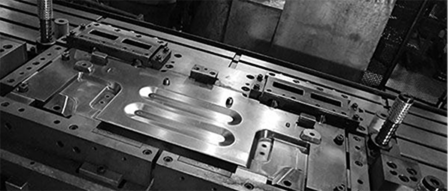
Fine blanking utilizes a triple-action press and a specialized V-ring blank holder. This setup clamps the material so tightly that it prevents the typical "bowing" or "dishing" effect seen in standard blanking. If your part requires a high degree of flatness (like a gear or a clutch plate), fine blanking is the superior choice.
3. Total Cost of Ownership (TCO)
While the initial tooling cost for fine blanking is higher, it often eliminates the need for expensive secondary operations such as milling, grinding, or deburring. For high-volume production of complex parts, fine blanking typically offers a lower total cost per part.
FAQs: Making the Right Choice Between Blanking Processes
When should I choose Fine Blanking over Standard Stamping?
You should prioritize Fine Blanking when your project requires high-precision functional components. It is the ideal choice if your parts demand:
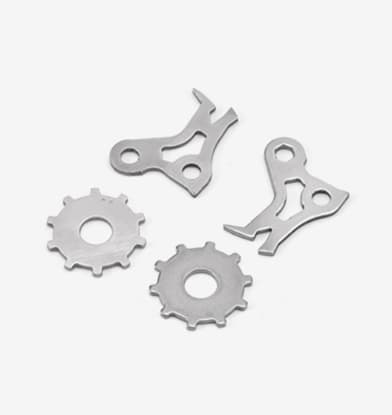
100% Smooth Edges: Essential for parts with moving contact surfaces like gears, cams, or ratchets.
Superior Flatness: Critical for components that must seal perfectly or maintain precise alignment.
Tight Tolerances: When your design specifies accuracy up to ±0.01mm.
Conversely, choose Standard Stamping (Blanking) for simpler structural parts where edge roughness is acceptable and minimizing initial tooling investment is your primary concern.
Does Fine Blanking reduce the overall production cost per part?
Yes, in many high-volume applications. While the initial cost of a triple-action press and specialized dies is higher, Fine Blanking reduces the Total Cost of Ownership (TCO) by:
Eliminating Secondary Operations: It removes the need for costly post-processing like grinding, milling, or manual deburring.
Reducing Material Waste: Higher precision often allows for tighter nesting on the metal sheet.
Streamlining Supply Chains: By producing a "ready-to-assemble" part in a single stroke, you reduce lead times and logistics costs associated with multi-stage manufacturing.

 English